

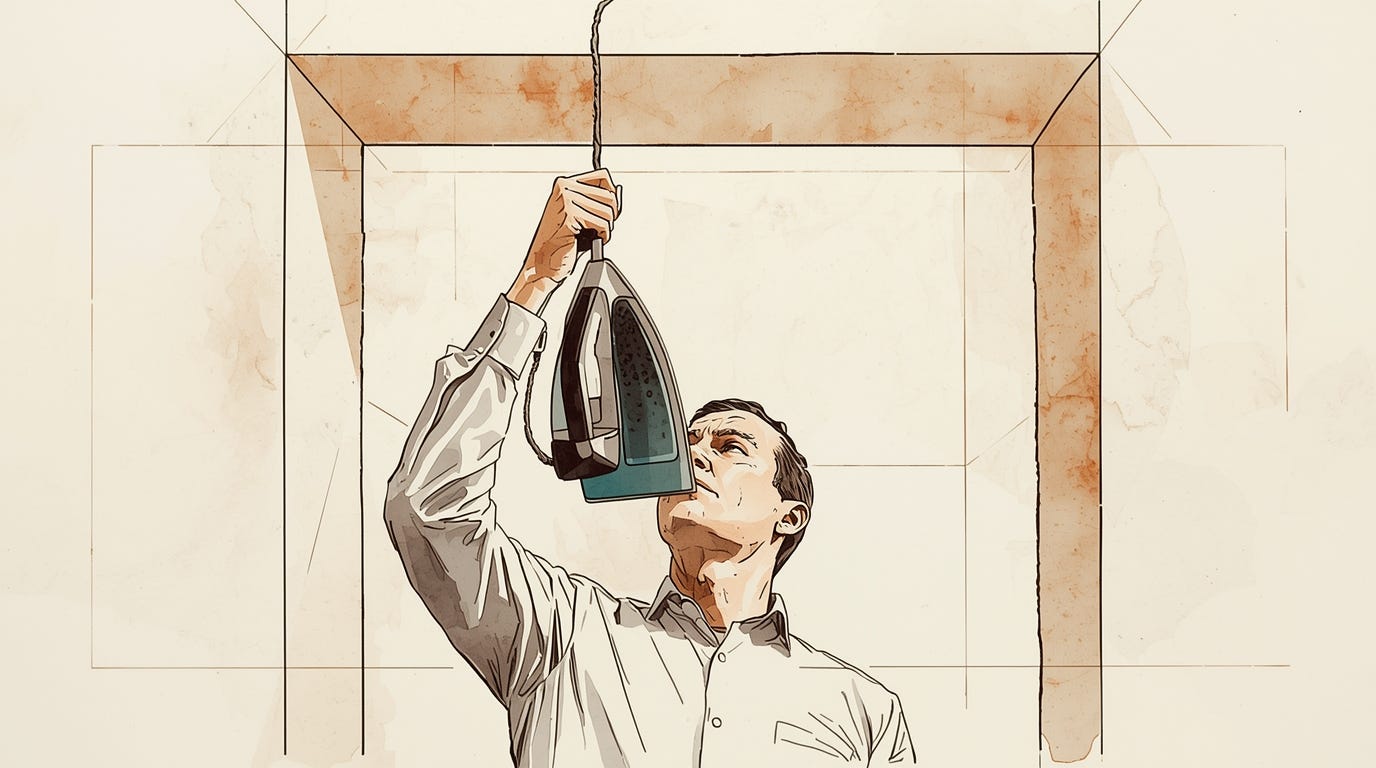
We like to think of ourselves as rational beings.
That our lives are shaped by conscious choices. That if we gather enough information, think carefully enough, and make good plans, things will work out. This assumption runs deep. It shapes how we work, how we educate, and how we explain success and failure.
And yet many of us have had moments that quietly contradict this story.
Moments when everything looked right on paper, but something inside felt deeply wrong. Moments where our bodies, moods, or behaviour seemed to know something long before our thinking caught up.
I ignored those moments for a long time.
For an entire autumn in 2005, I drove the same narrow road between Hilversum and the highway that would take me to the office. And every morning, without fail, the same question appeared in my mind.
What is the optimal speed to hit one of those trees so I don’t kill myself but hurt myself enough to get three months in the hospital?
It wasn’t a death wish. It was a wish to stop.
What made it confusing was that, rationally, I should have been happy. I worked for one of the most exciting IT companies at the time. I was on a clear career track, earned good money, had a loving relationship, and had recently become a father. By any reasonable standard, I had assembled all the components of a good life.
And yet, as soon as things went quiet, my whole system felt anxious, sad, and lost.
My mind kept saying everything was fine. My body and emotions clearly disagreed.
At first, I explained it away. A temporary dip. Stress. Lack of sleep. It will be better next week. Thinking harder felt like the responsible response.
It didn’t work.
Sleep deteriorated. A dull depression crept in. Eventually, it turned into apathy. I was still performing at work. From the outside, nothing looked wrong. But the cost of keeping up appearances, of numbing what I felt, became overwhelming.
In hindsight, this wasn’t a failure of rationality. Rationality was doing exactly what it was designed to do.
It just wasn’t listening to the right channel.
There is a simple example Tor Norretranders uses in The User Illusion that makes this easier to grasp.
Put your hand on a hot stove.
You don’t first think this is hot, evaluate the situation, and then decide to pull your hand away. Your hand is already moving before the thought appears. Consciousness arrives late, narrating what just happened.
The science behind this is not especially controversial. The unconscious mind is estimated to process around 11 million bits of information per second. Conscious awareness manages roughly 50. Consciousness is not a command centre. It is a bottleneck.
It gets stranger.
Research suggests that conscious awareness lags perception by around half a second. To preserve a sense of continuity, the brain edits experience retroactively so that perception and awareness feel simultaneous. What we experience as now is already slightly in the past.
The implication is uncomfortable.
Much of what we experience as rational decision-making is an explanation after the fact. Action, emotion, and judgement often arise first. Thought follows to organise or justify what has already occurred.
Once you see this, a familiar paradox makes sense. You can be articulate, competent, and successful, while something deeper has already started pulling your hand away from the stove. By the time consciousness notices, the system has been overheating for a long time.
Burnout is often described as a failure to cope. It may be more accurate to see it as a failure to listen.
After things became unsustainable, I changed my external circumstances. I daydreamed of a different life, tried to figure out what that could be, and eventually resigned to start my own consulting company.
It helped, but not in the way I expected.
The move was driven more by escape than by a grounded choice. I had changed the structure of my life, but I was still relating to myself in the same way. I was still trying to think my way into alignment.
The deeper shift came later.
I found myself drawn to Buddhism and began working with a life coach. What surprised me was that the practices that helped most were not analytical. They did not offer better answers. They changed the way knowing itself worked.
One simple sentence kept returning.
Don’t believe everything you think.
At first, this felt counterintuitive. Surely the way out of confusion is better thinking. Clearer thinking. More accurate thinking.
But slowing down revealed something else.
When I sat still, stopped solving, and paid attention without trying to control the experience, information began to surface that had never arrived as thoughts. Moods. Sensations. Images. A quiet sense of alignment or resistance.
This was not mystical. It was practical.
Slowing down widened the bandwidth of information I was willing to take seriously.
This is where meditation is often misunderstood.
It is not about surrendering agency or giving up control. It is about shifting where agency lives.
Before slowing down, most of my decisions were filtered through what I thought society, management, or other figures of authority expected of me. They were defensible. Rational. Easy to justify.
After slowing down, another question entered the process.
Does this action lead me toward a life I actually want to live?
The answer rarely arrived as a thought. It showed up as a felt sense of openness or contraction. Ease or resistance. A quiet yes or a quiet no that preceded explanation.
This is what freedom of choice began to mean for me.
Not choosing faster. Not optimising better. But choosing with access to more of the information already present in the system.
If most of what shapes our behaviour happens outside conscious awareness, then ignoring it is not rational.
It is negligent.
I had read The User Illusion nearly a decade before my burnout. At the time, it was intellectually stimulating. Interesting. Clever.
I didn’t get it.
The ideas only came alive when life forced the issue. When thinking alone was no longer enough to keep things together. Without the reading and curiosity, I suspect I would have burned out, recovered, and returned to the same race.
With them, I began to explore a different relationship to experience.
Slowing down did not give me answers.
It changed what I was able to hear.
If consciousness only hears a fraction of what we are, then the question is not how to think better.
It is what we miss when we never slow down enough to listen.
I’m curious where this lands for you.
Have you had moments where everything made sense on paper, yet something deeper disagreed? And if so, how did you respond to that signal?
This essay is part of Series I: The Inner Threshold, which stays with what disruption feels like from the inside before the way forward appears. These essays name that disorientation with precision, before diagnosis or strategy arrives. [See the full series here.]
Really appreciated your clear and spacious writing. Thank you for sharing your truth and insights. I will carry forward the awareness that slowing down gives me more access to my natural intelligence. But of course ! 🙏