
Anger Is Never the First Feeling
On the feeling that arrived before the one you noticed

You are in a meeting. Or a kitchen. Or a car on the way home from something that should have gone differently.
And then it is there. Not building gradually. Not arriving with a warning. Just there. A heat in the chest, a sharpness in the voice, a sentence that comes out harder than you intended.
Afterwards, you apologise. You soften. You explain it away as tiredness, or stress, or a bad day that finally caught up with you. And the person on the other side accepts the explanation, because they want to. Because it is easier than asking what actually happened.
But something stays. A residue. Not guilt, exactly. Something closer to confusion. Because for a moment, you did not recognise yourself. The reaction did not match the situation. It was too large for the room.
And that mismatch is where the real question begins.
Anger has already been categorised
For most professionals, anger has been categorised long before they arrive in a leadership role. It is a problem, a lapse, an emotional breach in an otherwise composed person. The literature on emotional intelligence, which has shaped an entire generation of leadership development, treats anger as something to regulate. To notice and redirect. To catch before it reaches the surface.
The corporate version of this is that anger should not appear. That a leader who loses their temper has lost something more important than the argument. The personal version, quieter and often older, is that anger means something is wrong with you. That it signals a deficiency in character, in patience, in the maturity you were supposed to have developed by now.
Both versions share the same assumption. Anger is the problem. Manage it better, and the problem goes away.
But anger is rarely where the story begins. There is nearly always something before it. Something quieter, less dramatic, easier to miss.
Fear. Hurt. Sadness. A moment where something mattered and was not acknowledged. A contribution that was passed over. A request that was heard as a demand. A conversation where you needed to be seen and were not.
What the anger was before it became loud
These feelings arrive first. They are the original signal. But they are quiet, and in many environments they are not welcome. Fear is weakness. Hurt is sensitivity. Sadness has no place in a boardroom or a busy household. So the signal does not get received. Not by the people around you, and often not by you either.
What happens next is not a decision. It is a conversion. The feeling that could not be received transforms into one that cannot be ignored. The sadness becomes sharpness. The hurt becomes blame. The fear becomes control. And what reaches the surface, what the room sees, is anger. It looks like it came from nowhere. But it came from somewhere very specific. It came from the place where the original feeling was not allowed to land.
Anger is not a loss of control. It is a bid for contact.
It says: something mattered here, and no one heard it. Not even me.
The volume is not aggression. It is the volume required when the original frequency was too low for the room. When the quieter feeling was sent and returned unopened, the system raises the signal. Not strategically. Not consciously. But with a logic of its own.
This does not mean every outburst is justified or that the impact on others can be waved away. It means the anger is not the root. It is the flower of a root that went untended. And if you only deal with the flower, the root sends up another one.
The first signal, not the last
There is a cost to managing anger without ever tracing it back. Leaders learn to catch it, breathe through it, respond instead of react. And often this works, in the sense that the anger no longer reaches the room. The system looks composed. The surface is calm.
But the original feeling has not been heard. It has only been rerouted. And over time, it goes underground. What emerges is not peace. It is something flatter. A withdrawal from the situations that used to provoke feelings. A quiet cynicism that protects against caring too much. A disengagement that looks, from the outside, like professional poise. The anger, for all its disruption, was at least still reaching for something. What replaces it is a system that has stopped trying altogether. And that is harder to come back from, because it does not announce itself. It settles in like fog.
The question is not how to manage anger better. It is whether you can hear the feeling that preceded it. Not to act on it. Not to make it the centre of every interaction. But to notice, in the moment before the heat arrives, what is actually asking for attention. What mattered. What was missed. What you needed that you did not know how to ask for, or did not believe you were allowed to need.
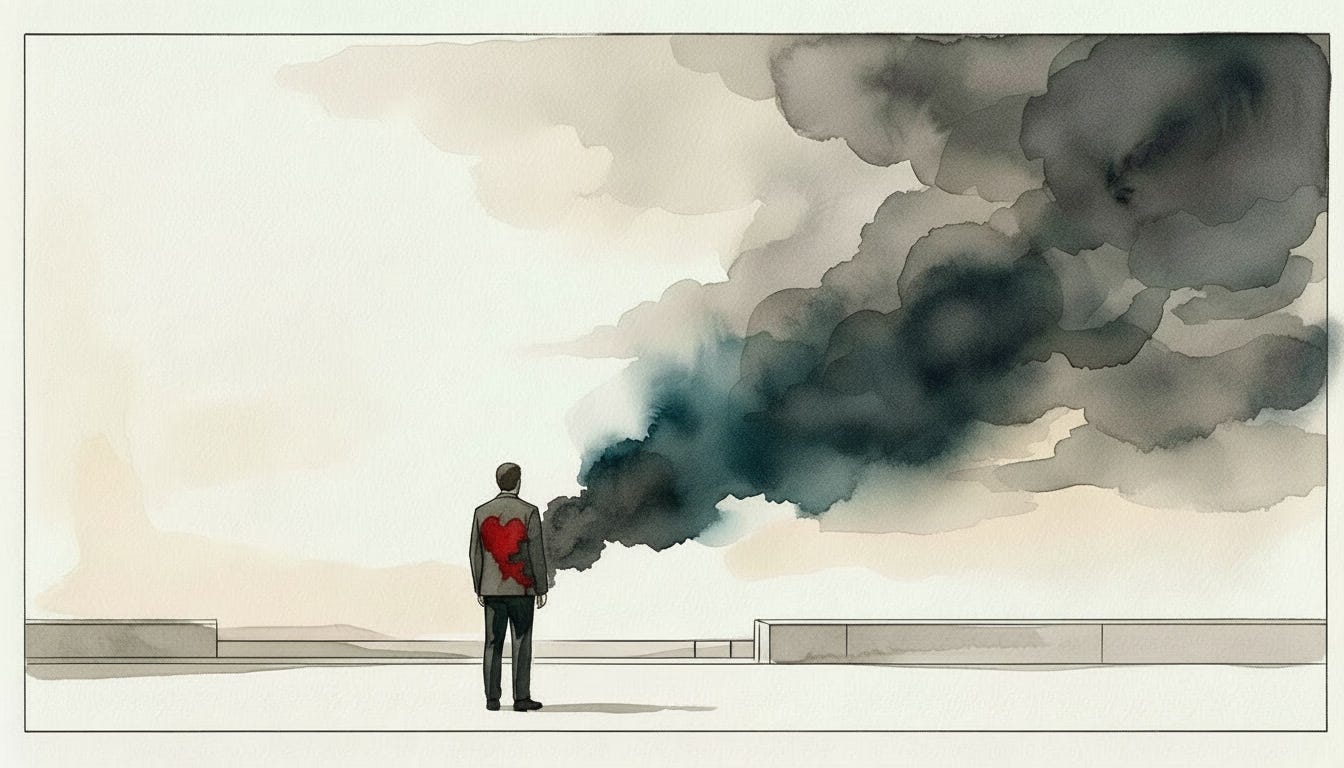
There is an image I return to often. Emotions are like clouds moving across a sky. Some days it is clear, and the sun gives its energy freely. Other days it is thunder. The clouds come and go. They always do. But most of us do not experience ourselves as the sky. We experience ourselves as the cloud. We are the anger. We are the fear. We are the storm.
The shift is quiet, but it changes the question entirely. If you can see the emotion as something passing through rather than something you are, you can turn toward it differently. Not how do I stop this, but what is this telling me? What story has been activated? What part of me has been touched that I did not know was still tender?
This is not a technique. It is a capacity. The inner architecture required to register what you feel before it converts into something louder. To become, even briefly, the sky rather than the cloud. Some people have built this over years of practice. Others are only beginning to notice that the architecture exists at all.
Anger will keep arriving. It is not something to outgrow. But it can become something to read differently. Not as a failure of composure, but as the last signal in a chain that started much earlier, with something softer, something more honest, something that only needed to be heard.
Reflective Question:
When anger last arrived in your life, what feeling was there just before it, the one that did not get heard?